


Cooking everyday, for every meal yields nasty, dirty, sink filled to the brim and overflowing sink. This photo is not for the squeamish. No amount of photoshopping can make this sight pretty.
My dishwasher is old and doesnt get out the oil stains and masala, H is always too tired to do the dishes, and I feel guilty asking him to do them because he has a job and im unemployed(Child rearing, bill paying and house renovation carpentry, cooking, laundry do not count).
I never buy bottled water, try to recycle, and yet every week i succumb to this.
Every week when I go to shop at BJs i see multitudes buying similar packs. I know they have replaced normal china or steel thalis in almost every house hold. And every time I reach out to buy them, a familiar war between sparing myself and the environment begins. Must i consign myself to doing dishes thrice a day , everyday, for 365 days a year as I have for the last four years?
8.14.2009
Paper- plate- Aholic: A rant
6.29.2009
My 300$ Kitchen renovation
or why I disappeared from my blog
Before Picture:
After Picture:
This is what happens when you watch one too many HGTV Home makeover shows!! I had really really horrible formica eurostyle cabinet doors which made my kitchen look absolutely awful. So, I bought unfinished cherry wood doors from Second Chance Inc Baltimore an architectural salvage place -They sell these really really cheap- and they were lying around the house for the last eight months before i finally got down to doing something with them. However the doors are all kept pretty hodgepodge and you will need exact dimensions of the doors you really need and an eye for consistent door design. I sanded the trim of the cabinets, then stained both the doors and the trim, added crown molding at the top of the cabinets to give it some height and finished off with new cabinet hardware - knobs and pulls. Ive had loads of fun so far doing this with the help of my husband.
Whats left? A new backsplash and countertop! I saw these fantastic antique tiles at Second chance inc and am going to design the back splash to match the buttercup yellow wall color and cherry cabinets with a cool focal point over the sink.
Great tip for all those looking for home makeovers on a budget is to find your local architectural salvage warehouse. Just google architectural salvage + your city. Its a green way to upgrade and wallet friendly as well.
Doing all the work yourself does require some effort, but im having fun teaching myself staining and carpentry work.
6.27.2008
JFI Tamarind: Panaka


Why oh why is June coming to an end? When almost all the blogs i know and love have an event submission deadline? :) This post has been in the works ever since JFI Tamarind was announced by Sig of Live to Eat.( JFI was started by Indira of Mahanandi - youve got to love the focus on uniquely indian ingredients).
Anyhoo, what began as a comic strip on the crazy adventures of our intrepid heroine imli aka Tamarind has mutated into a mini history slideshow on a beloved Indian Ingredient. But wait there's more( this is what happens when you watch one too many Kaboom adverts - wish I could go on a TV diet :))
There is also a recipe. Ha i knew you did not see that coming. That recipe however is thankfully a one liner, mix fruit juices with tamarind juice honey and water , attach ancient sanskrit name, panaka or panchamrutha sell for 500 rupees to unsuspecting foreigners as rejunuvating sanskrit waters.
But seriously, As a south Indian - tamarind is ubiquitous in almost all the foods I make. It also seems to be the "in" word for Indian Restaurant names in the US. Tamarind is the next India Garden( Every US city ive been to has an India garden - go figure). For Grandma backed authentic certified south indian food, always add Tamarind. The blacker the better - My grandma actually used to mail us tamarind from her village ( and in the Indian postal system it matured from brown youth to black old age). And then we used to play board games with the tamarind seeds, Dayakattai.
And now flashback over, quick summation - Tamarind has been around in Indian cuisine for what seems like forever- so much that even it has plenty of Indi in its official name, tamarindus indica. Wikipedia will tell you that it tamar al hind means Indian date, but did you know that Marco Polo was the first to write that down 800 yrs ago?
In vedic times, tamarind was also called chincha or amlika. It was commonly used in beverages and preserving meats. The seeds surprisingly were used to make a drink with whey.
So before you OD on tamarindus indica, heres wishing you khatta meeta imli times!
Note on the drawings: I sketched these with a black oil crayon and photoshopped the rest.
6.24.2008
Foodie Nerd: Maps & ideas
What is the one dream you want to achieve desperately? For me it is making a Trip to Paris- THE foodie mecca. I am going to try to learn some french, it sounds so musical right? Oui Oui! I want to stay there for atleast a month, take in the sights and the sounds all while stuffing myself merrily. Meanwhile inspired by this beautiful article on Chow on various foodie maps, Ive started in a very small way to map the sights and patisseries I want to take in when I do get to Paris. I will share the map here at Sometime Foodie when it is somewhat complete.
On other news for food nerds, Ive started inputting my blog recipes into a database at blist which is a free web based MS Access style database. I just thought its a cool way to look at various ingredients and regional styles. 
5.21.2008
The Healthiest Chappati

Disclaimer: I am not a nutrition expert. My only qualifications are my frequent dieter miles! Do let me know about errors logical or factual.
My entry for Srivalli's roti mela.
Srivallis Roti Mela has brought my inner mad scientist to life. Here are the results of my experiments to find the holy grail of all chappati flours, the very healthiest one to make the very healthiest phulka ( a chappati that puffs up into two layers).
In the tradition of long ago hot afternoons spent in my high school chemistry laboratory we begin with a
HYPOTHESIS: There exists the perfect chappati flour, which will puff up perfectly as a phulka- with low carbohydrates, high protein and loads and loads of vitamins and good stuff. This automatically eliminates all the mixed flour rotis like thalipeeth or thepla or parathas, which while perfectly healthy donot puff up into two layers.
What I did was try and mix different flours, soy, amaranth, even moong dal flour; with atta(durum whole wheat flour)in different proportions and make phulkas. Healthy stuff + healthy stuff must equal healthy stuff right? All the combinations had 1/4 cup of yoghurt and salt to taste. If you are looking for instructions to make phulkas from normal durum whole wheat check out Nupurs beautiful puffed up chappatis.
BASE INGREDIENTS: Per 1/4rth Cup
Wheat gluten is the protein part of wheat. It is commonly sold as vital wheat gluten from Hudson Mills. Iam not sure if it is available in India. My mother takes her soy beans to the local atta chakki and he makes it into flour for her. So people looking to source Amaranth flour or soy flour in India could try that idea.
METHODOLOGY / Different types of Chappati flour combinations tested:
Calorie information above is for the entire 11/2 cups of total flour. Each combination yielded 8 to 10 rotis. The proportion of all non wheat flours was limited to 33%( 1/2 cup of soy flour to every 1 cup of whole wheat) of the total. It says right on the back of the Amaranth and soy flour bags from arrowhead mills that you can substitute wheat flour with amaranth or soy upto 30% successfully.
RESULTS:
Taste: All the chapattis fluffed up beautifully. The tastiest was the Amaranth Wheat flour combination- per my chief taster my husband H.It had a slightly sweet, characteristic nutty sort of flavor. All the soy combinations had a slight bitterness if you had the chappati straight. With sabzi or dal this was not noticeable. The revelation was the soy wheat gluten combination - i had almost no hopes of anything tasty emerging - it was virtually the same as the wheat and soy roti and fluffed up nicely. The wheat gluten holds the roti together and helps it puff up like a normal roti.
I am sure you could add sugar to modify the taste of the soy rotis, but that would kind of miss the whole point of this experiment.
What does this experiment mean ? One thing is obvious, there is no real calorie advantage in these different rotis. The main advantage as I see it is increasing the quantity and type of protein you get from your roti.
I guess if you are on a diet or into heavy exercising the Soy Wheat gluten roti might be perfect for you, because this roti is really high in protein. triple a normal roti.It is also very high in iron, always good for anemic people.
If you are looking for a complete protein and heart benefits , the Amaranth Roti might be for you. Amaranth is also said to be easier to digest.
As a vegetarian, I am always looking for ways to integrate soy protien into my diet. At the end of this experiment I am glad that at the very least I can now make all my rotis into soy wheat flour rotis without sacrificing an iota of the look and feel of the traditional roti. Yippee!
4.25.2008
Harvesting Clove: A pictorial
My entry for Think Spice: Clove hosted by Gretchen at Canela & Comino.


Disclaimer:This is the process as described in Spice: The history of a temptation by Jack Turner. The drawings/sketches are mine. Iam not sure if this is still followed.
4.08.2008
Food Crisis: Grains Gone Wild & Maps
Paul Krugmans OpEd: Grains gone Wild published in the NYT today talks about the sudden sharp increase in Grain prices , so sharp as to qualify as a Worldwide food crisis. He says and I quote,"Over the past few years the prices of wheat, corn, rice and other basic foodstuffs have doubled or tripled, with much of the increase taking place just in the last few months".
He goes on to identify the some of the causes of this crisis, The war in Iraq, the Australian drought, increasing Chinese demand for meat, global warming etc. Modern Agriculture is dependent on Oil prices. Any increase in oil prices reflects in Food prices.
It would seem that a part solution to this problem is fairly obvious, an increased emphasis on Organic Food and Local Food. Organic Food uses non Fertilizer / pesticide based techniques of farming. The amount of miles your food travels adds to the total fuel cost and impact on the earth.
To give an example from my pantry, I have two packets of Frozen Okra or Bhindi- One bought in my local supermarket- comes to me all the way from China and the other- bought in the Indian Grocery store- comes from India. This brings me to the new map feature at Sometime Foodie.
I wanted to introduce a map feature to Sometime Foodie for a while now and finally did so yesterday in a panel in the left hand side. I am going to use it to keep a log of all my favorite foodie places in India and now after this article, to keep a log of the sources from which my food comes from. I want to see the mileage on my food.
I will end on a more positive and less alarmist note with this map from my favorite mapsite, American Memory on the Library of Congress website.
Pittsburgh 1902Map from Library of Congress
3.25.2008
Essay for Humblogistani 07: Revolution in a Thali
I am really sorry I have not hyperlinked the blogs and their recipes that Ive mentioned in my essay submission. My apologies. My only excuse is that I was in a tearing hurry. I hope to correct the omission within a week
UPDATE: Corrections and links hyperlinked March 26/08
HUMBLOGISTANI ESSAY 08
--------------------------------------------------------------------------------
REVOLUTION IN A THALI
I argue that India and Indians have a unique approach to food and that our predisposition to multicuisines is cultural and has been part of our capacity to absorb and assimilate various cultures over the centuries. I then look at how I think blogging has accelerated this process and laid the foundations of a cultural revolution.I then end by speculating on how far the new approach and the technology are going to take us.
In the first book I reviewed for my blog , Light of India, poet and philosopher Octavio Paz said of Indian food, “in India, the various dishes come together on a single plate. Neither a succession nor a parade, but a conglomeration and superimposition of things and tastes: a synchronic cuisine. A fusion of flavors, a fusion of times.”
The gujarati thali or the South Indian Banana Leaf, wherever I look at food in India his observation seems to ring true. In places I go to, Benares, the oldest cosmopolitan city in India I think- Idlis are being served steaming hot in one place and in another , its famous Banarsi Lassi. "Multicuisine" restaurants seem to dominate the Indian restaurant scene.But the best example I can give is close to home - my Mother because when I think food- good food, I usually think of my mother's cooking.
My mother makes dishes from her native Kanchipuram,or from occasional recipe swaps with her Gujarati neighbors and colleagues from all over India. Only now, over the last five years has she started cooking stuff shown on the television. Nothing unusual about this story, I am sure many people growing up in an Indian home had a similar experience. A fusion of flavors from different parts of India, but evolving rather slowly in spurts and starts.
Now think of the same process sped up and on steroids.
Every day, for atleast one meal, over a year.
That is exactly what I am doing these days. I blog about food and look at the work of fellow food bloggers-some indian and some international. A typical lunch, google vangi baath and and make it. Dinner the next day, Husband wants something different – its eggplant rollatini with linguini.
India's propensity towards “multi cuisine” has led to easy stereotyping of regions both in Indian homes and restaurants. South Indian means Idli Dosa, North Indian means naan and paneer butter masala. You will find paneer butter masala even in a remote hilltop in kerala and idlis in the equally remote kulu manali. True regional food rooted in the soil is mainly found in homes or perhaps the five star hotels. A mist of cheap ubiquity has shrouded the complex regional cuisines of India. The sharp focus on regional cuisine characteristic of Indian food bloggers has brought in focus the true complex tapestry that regional cuisine in India is.
Recipes like Kobbari kaaam podi from Indira or even Perugulu Ringulu from Asvadha, Bhakri from Kajals dreams or Chokha from Jugalbandi are traditional regional recipes from India. I could never have known about these recipes easily in America. My understanding of regional recipes and flavors of India are mostly from the food blogging world.
I envy the rootedness in regional cuisine that many Indian foodblogs have. In their cases, traditional seems easier to define, as the everyday food of a particular region in India. The food I make is not entirely the result of being an immigrant twice over, first from my native Tamilnadu to Gujarat and then to America. You could call it the schizophrenic food of a short attention span generation yuppie or quirk of my particular nature....or a way of life spawned by the multitude of mouth watering choices offered by the internet and more specifically food blogging .
Food blogging is very different from Food writing and instruction in traditional media like the television or books and creates a way of life with new traditions. It means readily accessible, high quality information on Indian and International food at any time of the day. Most other differences are part and parcel of the structural aspects of the internet and blogging.
Food blogging is an interactive experience. I know I have been been inspired not only the posts on some of the food blogs that I like, but I am also energized by the comments. I get a sense of community and food history from the comments. Food events are organized on a regular basis, from the JFI series to the AFAM. I participate in events that use ingredients or are about regional foods that I know nothing about. It only gives me an opportunity to understand and learn a little more about that culture or ingredient.
Food blogging is not only about food. Its vibrant personality and interests are as big as the person behind them. Its about photography, sustainability, food politics in my case, charitable work, arts and crafts. It can be controversial, thoughtful, insightful. Even when it is about the food, there is a skilled many times funny narrative, of mistakes made towards reaching that perfect phulka or the description of eating the first mango of the season.
Food blogging also enjoys freedom of expression. None of that boring flat politically correct stuff. I find a foodie book aunty like , I can call it aunty like. And then no need to keep my hands on my head to ward the brickbats away. In that sense, the internet is an hydroponic medium. No gravity, just become what you want to be.
Indian Food blogging breathes new life into traditional regional food by recording them but also gives birth to a new tradition of “authentic multi cuisine” by the access to recipes in India and world wide. It increases the focus on regional cuisines but also increases the scope of multicuisine in Indian homes. Will there be a breaking point? Will the balance tip? I now include Mexican and some baking in my already crowded repertoire of Continental, Gujarati, South Indian and Punjabi dishes. I think that Indian food blogging has now reached a critical mass of bloggers and readers to qualify as a genuine cultural revolution in the making.
It is a cultural revolution that betters my understanding of genuine regional cuisines, Indian and world. Unlike the established perception of cultural revolutions, the food blogging revolution does not undermine tradition – but supports it. Will Kanchipuram be the new Provence? I sure hope so.
3.05.2008
Flour Accounts

Look at them , like a proud family posing for a photo. All ten of them, members of my own pantry. Wow. Only a couple of relatives there too. Rice Flour, Maseca Corn Masa, Besan, Chapatti atta, Guilty secret white allpurpose flour, Moong atta, Corn meal, Urad flour, Semolina flour and I-dont-know-why-I-bought-it-Green-Split-Pea-Flour.
Jugalbandi's recent CLICK event on Flour made me think of all the Flour I had sleeping in my kitchen.
How many you got?
7.28.2006
Indian Oil
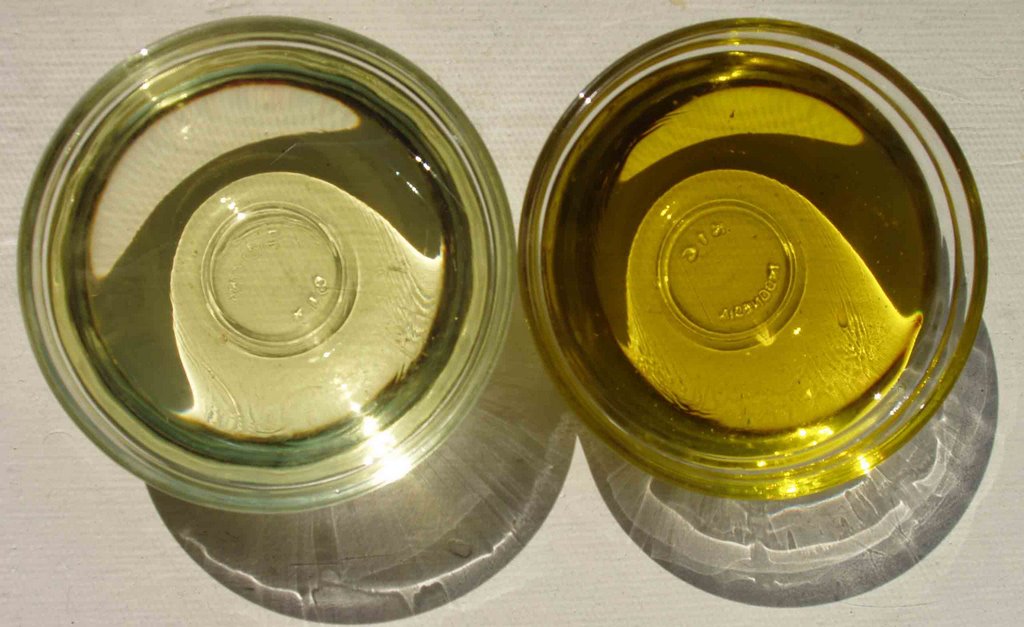
This post is in response to feedback on my earlier post : Stolen Harvest by Vandana Shiva.
When I vacillate between the tempting cold pressed olive oil and the prosaic canola at the supermarket, I struggle between two priorities - the healthiest and the most cost effective. This is a familiar recurrence of opposites, health and economics.Turns out what is perhaps a five minute decision for me is a complicated matter for a nation. Individual choice becomes the Market, a business in Edible Oils - or if you want to go all starchy on me, the Commodities market.
Indian Edible Oil Market: Per capita consumption of edible oils in India rose from 2 kilos in the 70’s, to 10 kilos in 2001 (That is still well below the US per capita consumption of 33 kilos). Oils in India are primarily sold as:Loose Oil - referring to unrefined oil sold in bulk without packaging or branding, constituting roughly 61% of all vegetable oils sold; Vanaspati - around 12% of edible oil consumption and Branded oil-constituting only 3% of all edible oils sold.
The Market being as big as it is, unfortunately is a bully. Poor individual me does not matter, I buy what they put out there.Now here is the fun part, Imports represent about 55 percent of India’s edible oil consumption today. This has had three consequences. Government disinterest in domestic oil production has increased Indian reliance on imports- mainly of soy and palm oil. It has decreased diversity and quantities of edible oils and brought the spectre of GM( genetically modified) oils to our door. With higher imports, come the dubious business practices of Multinationals.
Changing patterns of consumption and production have meant that palm and soybean oil consumption has increased, from mere 4% in 1970’s to 59% today (38% palm and 21% soybean) oil today. Around 4% of all soybean oil consumed in India is imported, mainly from Brazil and Argentina who grow transgenic soy or Genetically modified (GM) soy. India is also a major producer of soybeans and produces 18% of soybean oil consumed in India.
Next comes Vanaspati which has a double strike against it. Not only is Vanaspati bad for your health because of all those lovely trans fats it contains, the Dalda brand is also now owned by Bunge Agribusiness India, a subsidiary of Bunge USA. Vanaspati, to reiterate, is 12% of the Edible Oil business in India. My hunch is also that multinationals also bring with them exploitative farming practices - something i have to confirm.
What this short and quick survey also shows, is that the major opportunity for mischief, i.e adulteration, blending with cheaper oils etc is in the Loose Oils market, affecting the poorest of the poor. Much of the imported oils find their way to this vulnerable market.
What can you do in this situation ? As Michael Pollan says, vote with your fork; or in this case with your oil. Buy Local, avoid vanaspati, avoid soybean oil unless you know and trust the source, avoid Loose oils.
http://www.crnindia.com/commodity/soybean.html
http://www.ers.usda.gov/publications/OCS/nov03/ocs090301/ http://en.wikipedia.org/wiki/Transgenic_plants