


I read through cookbooks the way some people read magazines. The first thing i look for in a cookbook, is signs of personality, some idea of where the person comes from - that is generally a very good indicator of which recipes are the strongest. Some cookbook authors come across as being good eaters who ate far and wide enough to put out their recipes collected from good home cooks, yet others like Rose Levy Beranbaum come across as being entirely scientific in their fascination for food - each of her recipes is meticulously tested and rigorous in its precision. Madhur Jaffrey has been around forever, or so it seems to me , and is somewhat of a renaissance woman - she has acted, written a lot of cook books, hosted television cooking shows, opened restaurants.
I have read and cooked from many of her cookbooks- from her earliest, an Invitation to Indian cooking to Madhur Jaffreys World vegetarian. I was leafing through Curries and Kebabs: Recipes from the Indian spice trail(one of her best IMHO) when her description of her family in Delhi leapt out at me, something about her familys caste - the Kayasthas - being called Sharabi Kababi Hindus. How fascinating i thought , we generally like to think of religion and caste as these immutable, fixed creations - but with one sentence Madhur Jaffrey pointed out , very humorously , that the forces of religion and caste are constantly evolving.
That is the core of Madhur Jaffreys memoir - it is not really a cooks memoir. It is a fascinating lesson in history - what it meant to be a child growing up in the the 40's in North India in a well to do family. The book dishes out copious descriptions of meals, the way they were cooked(with rasoiyyas and maharajs) and consumed. But the tumultuous period in which she grew up ends up with the star billing of the book.
The book reads very much like your grandmothers favorite reminisces - "You know when we were little, your great grandfather had 20 cooks and he knew the vice roy of yada yada .....". At the same time she has a light touch with heavy topics - caste divisions, the emulation of British customs by indians and the reconciliation with Indian traditions etc.
I would highly recommend this book if you are a history buff.
5.25.2010
Book Review :Madhur Jaffrey: Climbing Mango Trees


2.25.2009
Book Review: Animal, Vegetable, Miracle
For us foodies, this recession has become the elephant in the room no one wants to talk about. Families everywhere are tightening their belts and economizing. How can I buy organic now? Organic foods typically cost atleast double of conventionally produced foods.
The other mantra of foodies is buy local, be a locavore. Reduce the carbon footprint of your food. For a while i took this really seriously, I even maintained a map of some of the food sources of the vegetables that I commonly bought from my farmers market.  Turned out I was unwittingly buying vegetables and fruits from Peru, Mexico, Italy and some frozen foods even from India. Then came an article in NYT where the whole "carbon footprint of my food" angle became complicated. Just because something is local doesnt necessarily mean its carbon footprint is lesser. Economies of Scale do make sense. It takes less petrol to cart stuff from somewhere far away than near, simply because of volumes.
At the end of this,I was scratching my head. Whats a politically conscious foodie to do?
Reading this book,"Animal, Vegetable, Miracle" by Barbara Kingsolver(visit the books website here) could not have happened at a better moment for me. At a time when external and logical stresses make the path of organic and local food difficult, this book is a timely reminder of the reasons why we should choose to eat organic food in the first place.
This book is the account of one ordinary middle class American family's decision to live for one year on only the food that they grew themselves on their own farm. An incredibly brave or stupid decision you might think but the insights that emerge from this process are incredible. We in the US have become used to buying whatever vegetables whenever we want. Our consumption of fruits and vegetables is not tied to location or season, because even if tomatoes cannot be grown in your frozen North eastern American soil, they can be easily imported from Mexico or the Caribbean.
The book follows the family through the months as they sow seeds and plant using organic practices, plan for the coming months , enjoy the harvest and finally put away vegetables and seeds for the winter. The book is packed tight with useful information on all sorts of related topics in little posts that populate the pages.All through out she makes a very, very, very strong case for eating organic food.
One very simple example she provides are eggs. Most hens in America are fed ANIMAL WASTE. Yes you read that right. Bits and parts of cows, pigs and poultry that remain after butchering are fed to hens in order to eliminate waste. These hens are crowded in to industrial sized sheds and then fed antibiotics to eliminate the diseases that emerge from animal overcrowding. Imagine the horror of cross contamination of animal diseases - mad cow disease jumping from cows to hens. In my minds eye, the simple act of feeding my daughter eggs bought from my nearby walmart became almost poisoning.
This is not really over dramatization, cross contamination is a reality of Industrial food growing today. Just remember the peanut butter, tomato and spinach recalls that have happened in recent months.
The author rues the death of a home cooking culture in America, which she posits as the main reason more people are eating fast and junk food. Even the worst home cooking is healthier than any processed foods we may buy outside. I can only filter this book through my Indian ness. As a community i think we retain a strong home cooking culture, my mother's idea of a woman leaning more towards a superwoman type of person - some one who is a professional and who tends to home and hearth. And to some extent, Barbara Kingsolver seems to fit that extreme - atleast in the book. She even makes her own cheese and butchers her own turkeys in this account - of course with the complete help of her husband and children.
In India, i think we are not as divorced from the soil as when we are here. Our families still pay heed to the harvests of rice and wheat and oilseeds. Buying them after harvest and storing them away for the whole year. Vegetables available in the market come from nearby regions and always are in season. You cannot buy a ripe alphonso in India in December. But Indians living in America do as the Americans do, we buy mangoes in winter, eat at the local McDonalds or Burger King and pass on to our children our love for Pepsi and Coke over water.
This book provides a compelling logic for a food culture that is aware of its time and place and points out the dangers of the Industrial farming culture of America.
Thanks to commenter Ann for recommending this book - I really enjoyed it.

11.11.2008
Book Review: Dont Try this @ Home

Many many of the essays deal with "accidents" in the kitchen and the resulting wonderful product. Others deal with the question of management of a professional kitchen and how cooking and management are two sides of running a restaurant. Yet other essays paint a wonderful picture of the culinary profession in the decades past.
I would highly recommend this book for pulling back the curtain on the professional kitchen.
7.12.2008
Book Review: In Defense of Food by Michael Pollan
During my grad school days in the US I travelled via bus to and from my University. On the bus, I was struck by how many poor people, who could not even afford their own car- were huge, overweight and obese. I was puzzled. In India being fat and obese is a mark of prosperity and wealth. If you think about the poor in the US, the reasons are clearer - Coke 1.89 litre is cheaper than water. Fast food burgers are the cheapest food and the most fattening. It is a very disturbing that it takes a lot more money and effort to buy vegetables, or meat and make healthy meals at home. It takes a lot more money to afford a gym. Being thin , slim in the US therefore, is a sign of being well off.
In 'In Defense of Food', Michael Pollan calls this phenomenon, "being overfed and undernourished". Why is this happening and what can we do about it? These are the primary questions raised and answered by Michael Pollan in 'In defense of food'. I am a longtime fan of Michael Pollan, and his many articles on food in the New York Times and via his books - two of my favorite works are Botany of Desire and Second Nature.
Michael Pollan begins with outlining the rise of "Industrial Agriculture" in the US, and its devilish spawn- the processed food industry. He is very entertaining and lucid as he reveals the true extent of their lobbying and marketing power. The extent of their manipulation of government and media is frankly frightening.
These might sound like big words, but everyday we, you and me; hear & see & read news reports saying that X ingredient is good for your health and then within six months we read that no, no actually X ingredient is bad for your health. In short, the scientists really donot know.
This is a direct result of Food Companies "sponsoring" research in food. Yesterday Oat bran was in fashion, today it is Omega 3. I guess they will put Omega 3 in your french fries too tomorrow- does that actually make your french fries healthier?
He names this manner of studying food, one ingredient at a time, nutritionism.He points out that this food fashion buisness does not really lead to any benefits in the long run and then goes on to suggest some really practical rules for all eaters leading to a healthy life and happy stomach.
Personally, i think this book is a MUST read for every foodie who wants the best for their family. Unless we realise how we are being manipulated by the food industry, in every meal and every snack - we cannot resist or more importantly - fight back.

5.29.2008
Book Review: Short history of the American stomach

Always a sucker for an attractive title, I picked up this new book at my local library recently. I am a history buff, but my knowledge of American history is limited to its urban history.
The parts I loved about the book, the parts that were smooth, informative and hilariously funny - about half the book, had a good comparison going on between past and present in way that made food history accessible to the layman. The very first chapter compares the cookbook craze of this era with that of a century ago. The very first chapter also has a hilarious comparison between Food network camera work and the shot angles of porn movies. Yes you read that right, the author gets a porn star to review food network and its video, which then segues into a short story on the frustrations of being a food network star. All very amusing and clever- but I did not get the slightest hint of any historical angle to this brief insight into food media.
I feel better that todays' twin sins of dieting and then desperate self starvation are very old ideas, and the author does do a good job of descibing the excesses of over and deliberate starvation centuries ago. The oldest reference in history that I can think of , of a people, a class - deliberately doing this to themselves are the Romans with their Bacchanalia. They used to eat ginormous quantities of food and then tickle the back of their throat to vomit the whole thing, and start the whole feasting process again. Whew - an orgy sounds more like work than pleasure to me today.
Some of the best ideas of the book however are underdeveloped and orphaned early. For example later in his book , the author Frederick Kaufman explores the relation between Food, its purity and spirituality. He goes on to explore how even the act of declaring a food pure enough to eat by a particular religion has become a big business.
The other good idea he has is the outsourced stomach. In these days of outsourced everything, why not the stomach? But this is where he focuses on minuteae and forgets the big picture. He focuses of a particular type of genetically reengineered Asian oyster which he laments is replacing all the native oyster species. I just do not get it, exactly which meal of his is completely american? My own garlic comes from China, my tomatoes from Italy, my Okra from China and India. Focusing on native / invasive species debate misses the wood for the trees.
My recommendation: Skip this book unless you have a good grounding in American History.
3.20.2008
Book Review: Eating India

The bookish cook strikes again!( thanks to barbara of Tiger and strawberries for a catchy self defining phrase) Eating India, An odyssey into the food and culture of the land of spices by Chitrita Banerji.When I saw this title in the library, I just had to read it.
I think that reading a book is partly like getting to know a person. You want to know where it comes from, does it belong to a family, what are its roots? You browse through it and if it catches your imagination, you read it through.
This book is by a Bengali food writer, Chitrita Banerji who has done a lot of food writing focusing on Bengal. Her writing, nay, her soul is rooted in Bengal - although she lives here, in the USA.
As you read through the book, your minds eye forms an image of an middle aged woman -thorough Bengali traipsing through India, using her connections to meet foodie people, and EAT. She name drops quite a bit, A famous artist here, a business man there. But essentially, she is on an eating tour and she recounts her tale region by region: Bengal, Goa, Gujarat, Bombay, Punjab , Hyderabad, Karnataka, Delhi , Benares and some more .
Her writing is peppered with interesting ideas, for example the idea of Weddings in India as cultural and Food snapshots. That is so true and I think so unexplored as a book. The second , Temples as repositories of traditional or authentic indian cuisine- so true( although ive run into this idea elsewhere too). Their style of cooking remaining unchanged over centuries. She draws cool inferences between historical politics in India and food.
The first road block is, what i like to call the "Burden of India". Every sand grain in India has a story and a history - boy what a history - 2000 years of it. When you weave history into a food tour, sometimes it works - many times it doesnt. The book detours into mini tourguide versions of the places she visits. Many times she draws interesting inferences, but mostly its deadweight.
Ok second road block, I think Ive been spoiled by Anthony Bourdain. Chitrita Banerjis approach strikes me as too safe and aunty like. Her preferred sources of information about actual food are the head chefs at the TAJ hotels. Every place she goes, from kerala to Bombay- she picks their brain for places to go and then straightaway you hear about those foods. The fun, experiential and adventurous approach of a foodie or even the homecook is sorely missing.
Where she also fails is in the cartography of food in India. Some places receive more attention and some less - so the book is pretty patchy if you want to know what to eat where in India.
Primarily this book should appeal to the Bengali exploring other Regional Indian Cuisines for the first time.
2.21.2008
Book Reviews: Heat & Kitchen Confidential
HEAT by Bill Buford
KITCHEN CONFIDENTIAL by Anthony Bourdain
As an ardent foodie, I spend a heck lot of time thinking and doing food. Cook it , take pretty pictures, write about it and finally eat it. Sometimes I wonder if I missed my calling as a maharaj, bawarchi, khansama or chef with my own paper hat painting my kadai canvass with mirchi , sriracha and jalapeno. But then I wonder what it would be like to be a professional cook, to cook all 365 days in a year. These two books are an attempt to gain some insight into this What if?
Chef Anthony Bourdain is familiar to many of us from his No reservations show on the Travel channel. Watch it on youtube below- Good for a few laughs at the least. His autobiographical book- Kitchen confidential published in 2000 is his and a professional cooks life described with no saucy detail left out.
Bill Buford on the other hand is one lucky son of a gun. A writer by profession , by his own admission, an amateur cook, knows enough celebrity chefs, AND gets to go work for them (the professionals) AND even publishes a book about the experience.
Both books complement each other, the professional and amateur providing fascinating insights into the inner workings of the restaurant business. I would definitely recommend reading them both.
Now Anthony Bourdain often resorts to shock jock posturing, casually flinging incendiary comments,- on vegetarians, "Vegetarians, and their Hezbollah-like splinter-faction, the vegans, are a persistent irritant to any chef worth a damn..." Emeril and many other people who attract his ire. Behind all this posturing though, is a story of an attempt to make a living by cooking. His intertwined drug addled personal epic distracts from the essential business of cooking which he does manage to describe in good detail. He points out, rightly i think, the importance of consistency over any sort of " artistic" delusions in professional cooking. The business itself is well covered from the birth pangs of restaurants, to menu planning and organizational skill required by chefs , to effective management tips.
To me as a woman, his descriptions of the professional cooking workplace sounds like a very sexist hell, male dominated and crude.
What i took from the book was the insight that the humble line cook is the star of the professional kitchen and an unthinking military style following is a very prized commodity in an underling but despised in a leader.
Bill Buford is more obsessed with actual food. The best pasta, the best meat and so on. He tries to learn how to make the best pasta by working at Babbo, Mario Batalis flagship restaurant in New York. I like Bill's book mostly for the gossipy stories of Mario Batali ( Ha he was a pot head too!) and Babbo. As for Bills quest for the best pasta, i found myself caring.... not so much. He is obsessive about details, going on and on about finding out when the egg made its entry into pasta dough. Maybe if this book was on indian food, i might have been interested. I am a cook and know that most of the time I just wing it. The first occurence of egg in pasta was most likely an accident, and in the nature of food, an un documented one.
In sum, both books are cool for their eye opening insider view of the restaurant business. Anybody willing to do it for indian restaurants?
8.18.2006
Fruit: An illustrated History by Peter Blackburn Maze
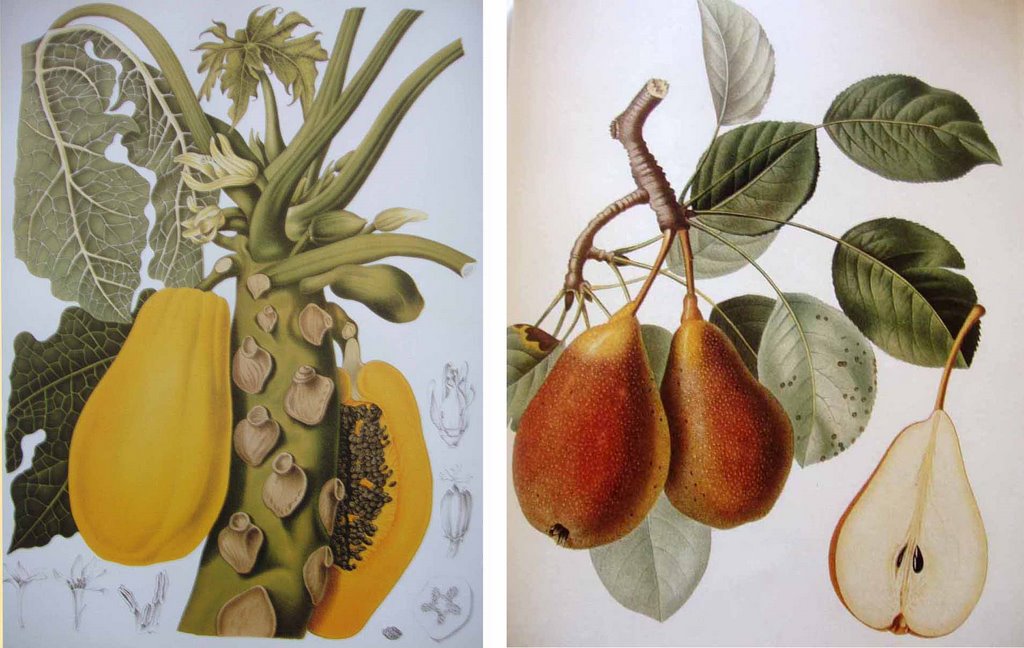
 Book Review :
A glossy coffee table book about what else :) fruits with average text but beautiful pictures...
Fun facts from this book:
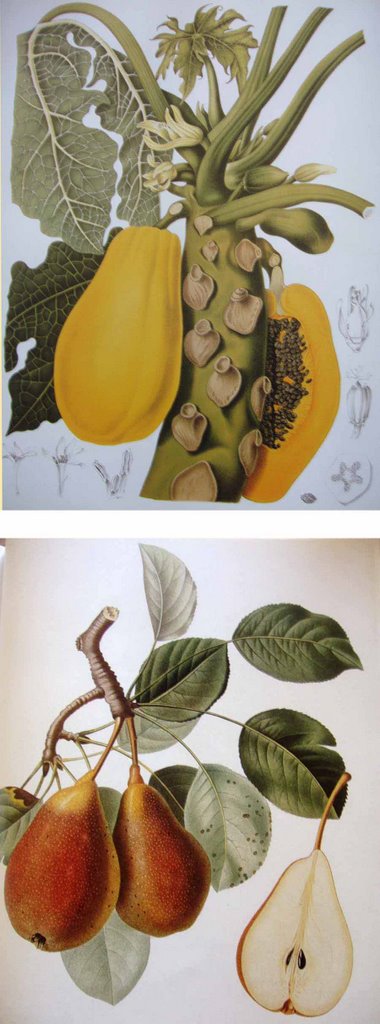
- Todays Citrus fruits probably arose from about a dozen wild species that originated in the region encompassing South East Asia and India.
- The scientific names of the pineapple - Ananas comosus and the Chickoo - Manilkara Sapote are surprisingly enough prevelant as common names in India. Pineapple and Chickoo are called Ananas and Sapota respectively in Gujarati.
Click on the Images to see a larger version.
6.28.2006
What to eat by Marion Nestle
 On my first visit to the US, about five years ago, my hostess took me on a trip to the local supermarket. I was overwhelmed and fascinated by the displays , the long isles and the number of product choices . I spent most of my grad school days trying to navigate and interpret these, because i cooked my food at home. The first challenge was the produce section - the supermarket had huge tomatoes, i was excited , but they only looked and felt like tomatoes, alas they did not taste like one. Shouldve been charged for impersonating a tomato. Vegetables, the mainstay of indian cooking were really really expensive. A pound of Eggplant was almost 3$, around 150 rupees. I couldve bought one in india for as little as 10 rupees. This situation lasted until i discovered the local farmers market for a wider variety of cheap veggies.
Bread was another challenge.With no guidance, i took to subjecting the brands of bread i bought to what i called the soaked in milk test. Back home i would soak a slice of bread in milk sprinkle a little sugar and voila - dessert. The bread soaked up the milk and retained its shape, and gave a good bite. I soon discovered that breads which were very light, more air than dough did not pass this test. Going through all the brands in the supermarket, including the wonderbread i had read so much about , i discovered bakery bread and artisan bread, finally getting into baking my own bread.
With time supermarkets in the US have become less intimidating places for me. But with marion nestles book i feel like i have been handed the key to navigating american supermarkets, a tourist guide and a pretty comprehensive one at that. The first real clue that i got to the aggressiveness with which supermarkets are planned are their layouts. Stick to the periphery and dont got towards the centers. Only 5% ( or some small figure like that) of customers manage to stick to their shopping lists. She then proceeds on a walk through the supermarket, through produce, bread, milk, eggs, meat, fish, the center aisles*, beverages*, and special sections*. Along the way she interprets labels and nutrition information for us along with juicy tidbits on the amount of political fighting it took to reach these.
The main issues she focuses are on are both dietary( eat less, portion size, nutrients and what they do to you) environmental ( organic, fair trade, humane treatment cows and birds) and political( the sordid marketing practices of multinationals, the price of a potato to potato chip, selling to children). She points out how ownership of these corporations, Altria specifically with its ownership of phillip morris and krafts results in marketing practices being 'imported' from 'hazardous' industries into food marketing.
Supermarkets back home are getting bigger( with ice berg lettuces being sold in a hot AZ Phoenix like Indian city for 600 rupees - about 12$ a head :)) . Marion nestles book gives me insights into the ways these will evolve too. With this guide to American supermarkets and their products, i need to look at the indian food scenario under a similiar framework.
*Center Aisles: Processed foods, Sugars, Cereals, Packaged foods, Snack foods, Foods just for kids, Oils
*Beverage Aisles : Water, "Healthy" Drinks, Teas and Coffees
*Special Sections: Infant formula, Supplements, Bakery
What to Eat - Marion Nestle Review of the book at NYT
http://whattoeatbook.com/index.html
http://www.foodpolitics.com/
Curry by liza collingham
 Growing up in a medium sized indian city, the only place i ran into the word curry was on the menus of restaurants serving chinese, continental , punjabi and south indian food all at once. Thankfully such outings were rare. Curry was a word very much on the periphery of food, indian or otherwise. So a book on Curry, with all its 'indian' associations - very tempting.
The pattern of cultures and countries mingling and evolving new hybrids of food in india should be familiar to any one with an aquaintance with indian history and religion. Our (the Indian) capacity for assimilation and reworking of unfamiliar ideas into something at once strange and familiar is truly unparalled. In culinary terms, this has worked for indians in india and the indian diaspora - which brings to mind liza cunninghams accounts of indian food in indonesia, africa, mexican punjabi , indian chinese( which is becoming quite big in the US i gather) and the like.
Liza cunninghams book also unearthed memories of food at temples ive visited over the years. From the sundal and pongal of our annual trips to tirupati, to the exquisite sweets made at Nathdwara's Krishna temple... Temples as centres of cuisine were unearthed and made explicit.
She ends with the beginnings of marketed food in India, Tea and Dalda ( Hydrogenated oil). Now that is another interesting story waiting to be told.
Lizzie Collingham "Curry: A Tale of Cooks and Conquerors" Find the comprehensive New York Times Review (NYT) here.
Short table of contents:
Pre Mughal : Primarily vegetarian, few records from the Royal Courts. Temple cuisine.
Mughal: Babur and the Central asian influence.
Portugese: and how the vindaloo was born
Colonial: Cutlets and the curry boom
Post Colonial : A British impression of indian food and vice versa.
Present: India twice removed, indian food in indonesia, japan, usa and of course britain.
6.10.2006
Stolen Harvest by Vandana Shiva
 Just got this book from the library. After a fast read i am fuming, steaming with smoke pouring out of my ears! Here is my fast and furious take aka book review.
This book is organized into short essays which have the following themes:
1. The concentration of world agriculture in 6 corporations
Seed patents and crop patents and their monoculture cultivation
2. Shrimp farming and destruction of Seabeds
3. Cows as only milk and meat producers
4. Soybean Oil and Oil domination
Her tone is passionnate, and she illustrates her case with headline making news in India. Vandana Shiva is against the processes of globalization and industrialization . She contrasts the earlier, more earth friendly, ecological practices in India to current multinational corporation practices. For example, in farming the shift from a dung fertilizer, multi crop rotation scheme to monocultures and genetic engineering.
Sounds great so far. So why my allergic reaction? First thing to make clear is I am sympathetic to all her causes, anti globalization, anti jumbo corporation and all that. But Vandana Shiva writes as an activist only can. Her style is rabble rousing, and provides a small picture bursting with indignation. Its nostaligia for the past is palpable and questionable for its claims of an ecological eldorado.
Why do i feel this? Take for example The Oil Story. Multinationals supposedly want to take over the oil market in India, not only do they flood the country with cheap soybean oil, they also adulterate local eco friendly oil methods. OK. So i go back to my experiences buying oil in India and think - did i really have to choose unilever cooking canola oil? Was there no similiarly priced alternative? Did i eat at an local Macdonald equivalent which might have meant a high soy bean oil consumption on my part.
The answer is NO. I had a wide variety in choice and price with local brands and a variety of oil types to choose from - sesame, castor, peanut, mustard and of course sunflower oil. Was there a macdonalds? Nope , there was only saravanas, and it is a chain of all of 20 outlets. Not even a measly amoeba in the super size me world of the Big Macs.
In short, verifying what i read- with my experience of india leads me to the conclusion that her writing has a lot of bogeyman claims. I agree that multinationals are cut throat enough to engage in practices that border on conspiracies. But i think she needs a more comprehensive picture, backed up with data and statistics to support her claims.
6.02.2006
In Light of India by Octavio Paz
 Excerpt from In Light of India
"Food, more than mystical speculations, is a reliable way to approach a people and its culture. I have mentioned that many of the flavors of Indian food are the same as Mexican. There is, however, one essential difference, not in flavor but in presentation: Mexican cuisine consists of a succession of dishes....In European cooking, the order of the dishes is quite precise. It is a diachronic cuisine, as Claude Levi Strauss has said, in the which the dishes follow one after the other in a sort of parade interrupted by brief pauses. It is a succession that evokes th eimage of a military march or a religious procession. It is in itself a theory(italics by Paz), in the philosophical meaning of the word: European cuisine is a demonstration.....A radical difference: in India, the various dishes come together on a single plate. Neither a succession nor a prarade, but a conglomeration and superimposition of things and tastes: a synchronic cuisine. A fusion of flavors, a fusion of times.
....I realized that its ( indian food) secret is not a mixture of flavors, but rather a graduation of opposites that are simulataneously pronounced and subtle. Not a succession, as in the West, but a conjunction. It is a logic that rules nearly all Indian creations."
5.26.2006
Food On Paper
Some of the best cookbooks on Indian i have run into so far
1. Shivaji Rao Holkar & Shalini Devi Holkar "Cooking of the Maharajas"
Unfortunately this book is out of print now, you might find it on amazon or in your local library if you are lucky. A very well written book on Royal food complete with cuisine from a dozen fiefdoms with anecdotes to match.
2. Madhur Jaffrey
Indian Cooking Barrons Educational Series 1983
Flavors of India West 175 Publishing 1995
From Curries to kebabs Recipes from the Indian Spice Trail Clarkson Potter Publishers 2003
3. Others :
Jeffrey Alford & Naomi Duguid Mangoes & Curry Leaves: Culinary Travels through the great subcontinent Artisan 2005
4. My current reading list / wish list :
Maya Kaimal
What to Eat - Marion Nestle
5. Articles
Lizzie Collingham "Curry: A Tale of Cooks and Conquerors"
Find the New York Times Review (NYT) here
Famous chefs talk about their favorite out of print cookbooks
Might require membership to NYT for access
The New Puritans - New York Times
Analysis of the wave of books hearkening to organic, nutritious, anti big corp food