


Paul Krugmans OpEd: Grains gone Wild published in the NYT today talks about the sudden sharp increase in Grain prices , so sharp as to qualify as a Worldwide food crisis. He says and I quote,"Over the past few years the prices of wheat, corn, rice and other basic foodstuffs have doubled or tripled, with much of the increase taking place just in the last few months".
He goes on to identify the some of the causes of this crisis, The war in Iraq, the Australian drought, increasing Chinese demand for meat, global warming etc. Modern Agriculture is dependent on Oil prices. Any increase in oil prices reflects in Food prices.
It would seem that a part solution to this problem is fairly obvious, an increased emphasis on Organic Food and Local Food. Organic Food uses non Fertilizer / pesticide based techniques of farming. The amount of miles your food travels adds to the total fuel cost and impact on the earth.
To give an example from my pantry, I have two packets of Frozen Okra or Bhindi- One bought in my local supermarket- comes to me all the way from China and the other- bought in the Indian Grocery store- comes from India. This brings me to the new map feature at Sometime Foodie.
I wanted to introduce a map feature to Sometime Foodie for a while now and finally did so yesterday in a panel in the left hand side. I am going to use it to keep a log of all my favorite foodie places in India and now after this article, to keep a log of the sources from which my food comes from. I want to see the mileage on my food.
I will end on a more positive and less alarmist note with this map from my favorite mapsite, American Memory on the Library of Congress website.
Pittsburgh 1902Map from Library of Congress
4.08.2008
Food Crisis: Grains Gone Wild & Maps
7.28.2006
Indian Oil
This post is in response to feedback on my earlier post : Stolen Harvest by Vandana Shiva.
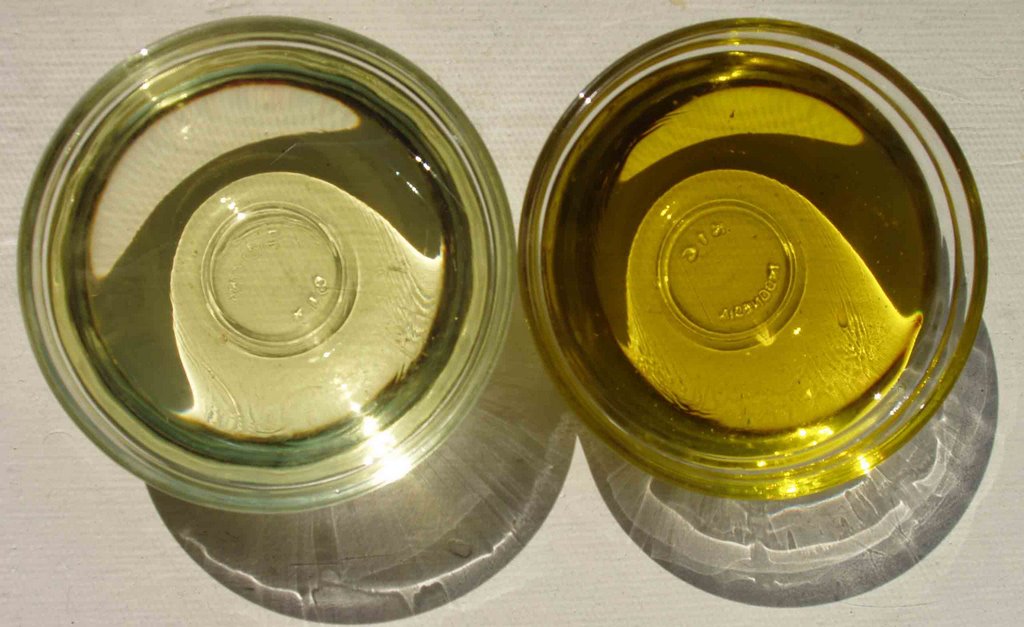
When I vacillate between the tempting cold pressed olive oil and the prosaic canola at the supermarket, I struggle between two priorities - the healthiest and the most cost effective. This is a familiar recurrence of opposites, health and economics.Turns out what is perhaps a five minute decision for me is a complicated matter for a nation. Individual choice becomes the Market, a business in Edible Oils - or if you want to go all starchy on me, the Commodities market.
Indian Edible Oil Market: Per capita consumption of edible oils in India rose from 2 kilos in the 70’s, to 10 kilos in 2001 (That is still well below the US per capita consumption of 33 kilos). Oils in India are primarily sold as:Loose Oil - referring to unrefined oil sold in bulk without packaging or branding, constituting roughly 61% of all vegetable oils sold; Vanaspati - around 12% of edible oil consumption and Branded oil-constituting only 3% of all edible oils sold.
The Market being as big as it is, unfortunately is a bully. Poor individual me does not matter, I buy what they put out there.Now here is the fun part, Imports represent about 55 percent of India’s edible oil consumption today. This has had three consequences. Government disinterest in domestic oil production has increased Indian reliance on imports- mainly of soy and palm oil. It has decreased diversity and quantities of edible oils and brought the spectre of GM( genetically modified) oils to our door. With higher imports, come the dubious business practices of Multinationals.
Changing patterns of consumption and production have meant that palm and soybean oil consumption has increased, from mere 4% in 1970’s to 59% today (38% palm and 21% soybean) oil today. Around 4% of all soybean oil consumed in India is imported, mainly from Brazil and Argentina who grow transgenic soy or Genetically modified (GM) soy. India is also a major producer of soybeans and produces 18% of soybean oil consumed in India.
Next comes Vanaspati which has a double strike against it. Not only is Vanaspati bad for your health because of all those lovely trans fats it contains, the Dalda brand is also now owned by Bunge Agribusiness India, a subsidiary of Bunge USA. Vanaspati, to reiterate, is 12% of the Edible Oil business in India. My hunch is also that multinationals also bring with them exploitative farming practices - something i have to confirm.
What this short and quick survey also shows, is that the major opportunity for mischief, i.e adulteration, blending with cheaper oils etc is in the Loose Oils market, affecting the poorest of the poor. Much of the imported oils find their way to this vulnerable market.
What can you do in this situation ? As Michael Pollan says, vote with your fork; or in this case with your oil. Buy Local, avoid vanaspati, avoid soybean oil unless you know and trust the source, avoid Loose oils.
http://www.crnindia.com/commodity/soybean.html
http://www.ers.usda.gov/publications/OCS/nov03/ocs090301/ http://en.wikipedia.org/wiki/Transgenic_plants
7.02.2006
Milk in India
I just finished reading Marion Nestles book, What to Eat. She gives a comprehensive walk through tour of an American Supermarket with nutritional, dietary and political commentary thrown in. In her chapter on milk she describes how milk is collected from many cows, all fat extracted - and then added back according to required percentages. From a nutritional standpoint, she warns against consuming too many saturated fats from dairy products - a primary source for vegetarians.
Other critical issues are the use of growth hormones like rbst , usually with high amounts of antibiotics typically peddled by multinational companies.
I have bucolic memories of fresh buffalo milk being delivered to our doorstep. Only years later , did we make the transition to milk in plastic sachets, and finally to a lower fat % milk. I wanted to test out this eldorado of milk memory- was i actually consuming rbst and antibiotics as a child? Here is a quick answer.
Milk in urban India is a child of that 60's miracle called Operation Flood. Funded primarily by foreign sources, it was remarkable for two features- incorporating social equity by using cooperatives and of course for making milk available everywhere in India. Milk supply in India is changing atleast on the first count - the influx of multinationals. A case in point is Dynamix, a company whose 49% of equity is held by Shreiber international, an American multinational. With operations set up in Baramati, Maharashtra - its products are snapped up by other multinationals such as Mc Donalds for which Dynamix is a major supplier.
On the other hand are numerous small time players, usually city specific. While rbst has been banned in India according to most internet resources, several organisations have found high concentrations of antibiotics and pesticides ( like urea) in milk and carbonated drinks.
Should you be worried about the milk your children consume in India? If you are lucky to have a consumer education society in your city , best check their reports from periodically to make sure your brand of milk meets all specifications. Some reports can be found at http://www.cercindia.org/ .
6.10.2006
Stolen Harvest by Vandana Shiva
 Just got this book from the library. After a fast read i am fuming, steaming with smoke pouring out of my ears! Here is my fast and furious take aka book review.
This book is organized into short essays which have the following themes:
1. The concentration of world agriculture in 6 corporations
Seed patents and crop patents and their monoculture cultivation
2. Shrimp farming and destruction of Seabeds
3. Cows as only milk and meat producers
4. Soybean Oil and Oil domination
Her tone is passionnate, and she illustrates her case with headline making news in India. Vandana Shiva is against the processes of globalization and industrialization . She contrasts the earlier, more earth friendly, ecological practices in India to current multinational corporation practices. For example, in farming the shift from a dung fertilizer, multi crop rotation scheme to monocultures and genetic engineering.
Sounds great so far. So why my allergic reaction? First thing to make clear is I am sympathetic to all her causes, anti globalization, anti jumbo corporation and all that. But Vandana Shiva writes as an activist only can. Her style is rabble rousing, and provides a small picture bursting with indignation. Its nostaligia for the past is palpable and questionable for its claims of an ecological eldorado.
Why do i feel this? Take for example The Oil Story. Multinationals supposedly want to take over the oil market in India, not only do they flood the country with cheap soybean oil, they also adulterate local eco friendly oil methods. OK. So i go back to my experiences buying oil in India and think - did i really have to choose unilever cooking canola oil? Was there no similiarly priced alternative? Did i eat at an local Macdonald equivalent which might have meant a high soy bean oil consumption on my part.
The answer is NO. I had a wide variety in choice and price with local brands and a variety of oil types to choose from - sesame, castor, peanut, mustard and of course sunflower oil. Was there a macdonalds? Nope , there was only saravanas, and it is a chain of all of 20 outlets. Not even a measly amoeba in the super size me world of the Big Macs.
In short, verifying what i read- with my experience of india leads me to the conclusion that her writing has a lot of bogeyman claims. I agree that multinationals are cut throat enough to engage in practices that border on conspiracies. But i think she needs a more comprehensive picture, backed up with data and statistics to support her claims.